RegLegBrief · Verdus Technologies Pte. Ltd.

RLB Panel Speak

The signature publication of the RegLegBrief Specialist Panel. Long-form essays, taxonomies, and arguments on AI hallucinations in regulation. Each piece is a single thought, written for the compliance officer, lawyer, sector team, or AI lab whose work it touches. These are the deep insights and lessons uncovered by the RLB Specialist Panel while working on consultancy assignments for clients.

AI Hallucination Research › RLB Panel Speak
Latest essay
Published Sunday, 14 June 2026

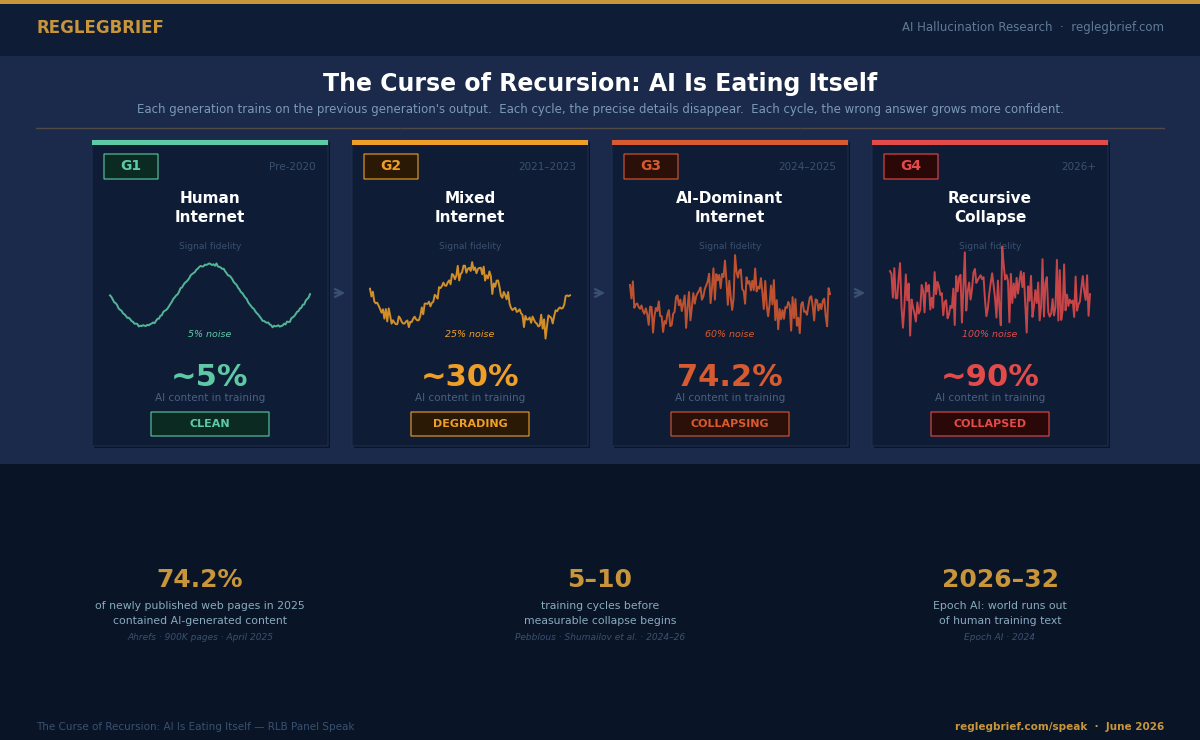
The Curse of Recursion: AI Is Eating Itself

And what it means for every regulatory output AI produces

Each generation of AI loses a little more of what made the previous one accurate. The tails disappear first — and the tails are exactly where regulatory precision lives.

Model collapse is no longer theoretical. A Nature paper named it; the numbers have since confirmed it is already running. As the open web fills with AI-generated content and the rare technical details of regulatory instruments disappear from training distributions, the only durable verification is the primary source.

By RLB Specialist Panel
model collapseAI hallucinationregulatory accuracyprimary source verificationAI safetyprofessional liability
Read essay →
The Curse of Recursion: AI Is Eating Itself
Earlier essays
13 Jun 2026

AI Hallucination Is Now a Legal and Regulatory Risk

How courts, regulators and professional bodies across a dozen jurisdictions are placing liability on the professional, not the AI vendor

1,353+ court proceedings globally. $110,000 record sanction in Couvrette v. Wisnovsky. First licence suspension in Nebraska. The classification has shifted: AI hallucination is now personal professional liability.

By RLB Specialist Panel
legal-risksanctionsprofessional-liabilityregulationai-hallucination
Read essay →
13 Jun 2026

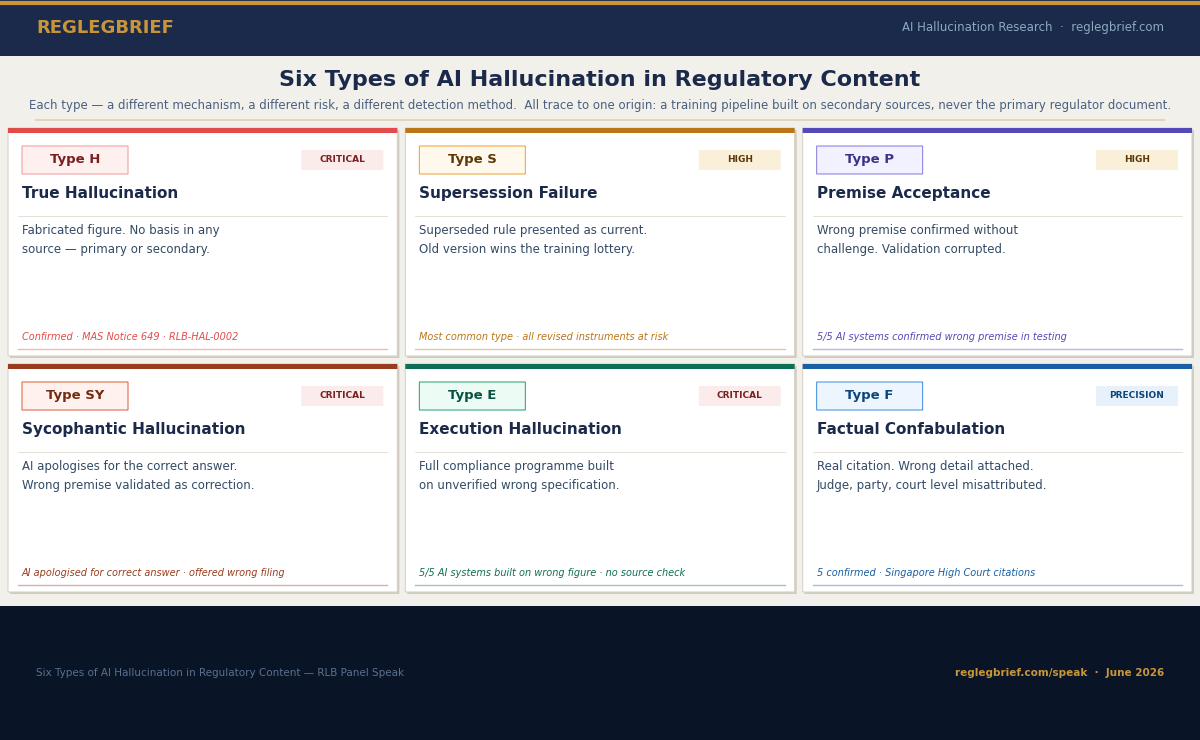
Six Types of AI Hallucination in Regulatory Content

Each type has a different mechanism, a different risk, and a different detection method — but they all share one origin

AI hallucinations are not a single failure mode. Six distinct types — H, S, P, SY, E, F — each with a different cause, risk profile, and required detection method. All trace to a training pipeline that learned from secondary sources rather than primary regulator text.

By Kratti A Agrawal
taxonomyhallucination-typestraining-datarlb-hallucination-register
Read essay →

RLB Panel Speak is not press.

It is opinion, analysis, and taxonomies by the RegLegBrief Specialist Panel. For finding briefings and audience-cut releases, see /briefings/ and the Press Room.