Singapore's Ministry of Transport and Ministry of Home Affairs introduce the Cross-Border Railways (Border Control Co-Location) Bill 2026 to enable Malaysian preclearance officers in the Woodlands North Designated Area and Singapore preclearance officers at Bukit Chagar — supporting the December 2026 launch of the 4-kilometre Johor Bahru–Singapore Rapid Transit System Link.
Cross-Border Railways (Border Control Co-Location) Bill 2026 (Bill No. 10/2026 · Pub 7 April 2026)
On 7 April 2026, the Cross-Border Railways (Border Control Co-Location) Bill (Bill No. 10/2026) was introduced for First Reading in Parliament; the Bill was passed at Second Reading on 5 May 2026 and awaits Presidential assent. It is a joint Bill of the Ministry of Transport and the Ministry of Home Affairs that operationalises the Johor Bahru–Singapore Rapid Transit System (RTS Link), a 4-kilometre cross-border line connecting Woodlands North in Singapore with Bukit Chagar in Johor Bahru, with five-minute journey times and capacity for 10,000 commuters per hour each direction. RTS Link operations are scheduled for December 2026.
The Bill runs to eight Parts covering: co-location of border control area in Singapore (Part 2); border clearance and railway security checks by Malaysia in Singapore (Part 3); reciprocal Singapore operations in Malaysia (Part 4); cross-border incident management (Part 5); data residency and inviolability (Part 6); and concurrent criminal jurisdiction (Part 7). Consequential amendments are made to the Immigration Act 1959, the Civil Defence Act 1986, the Police Force Act 2004 and the Passports Act 2007.
The regulatory rationale, set out in the Ministry of Home Affairs press release of 7 April 2026 and the Wrap-up Speech of the Minister for Law and Second Minister for Home Affairs at Second Reading on 5 May 2026, is the user-experience and operational efficiency case for single-clearance travel: every passenger clears immigration once, at the point of embarkation, rather than twice as on the existing Causeway and Second Link road crossings. Co-located customs, immigration and quarantine facilities at each terminus are the technical means.
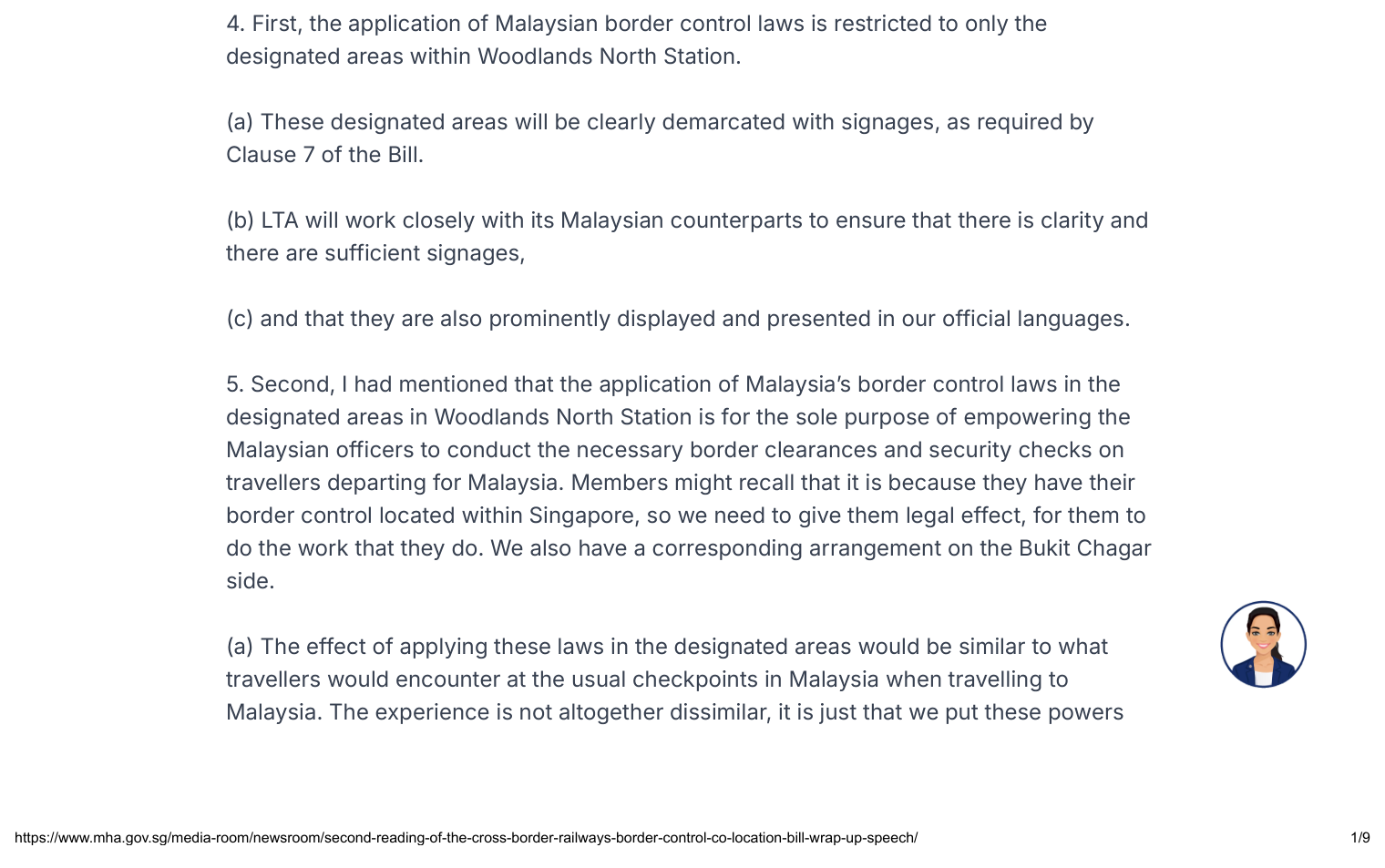
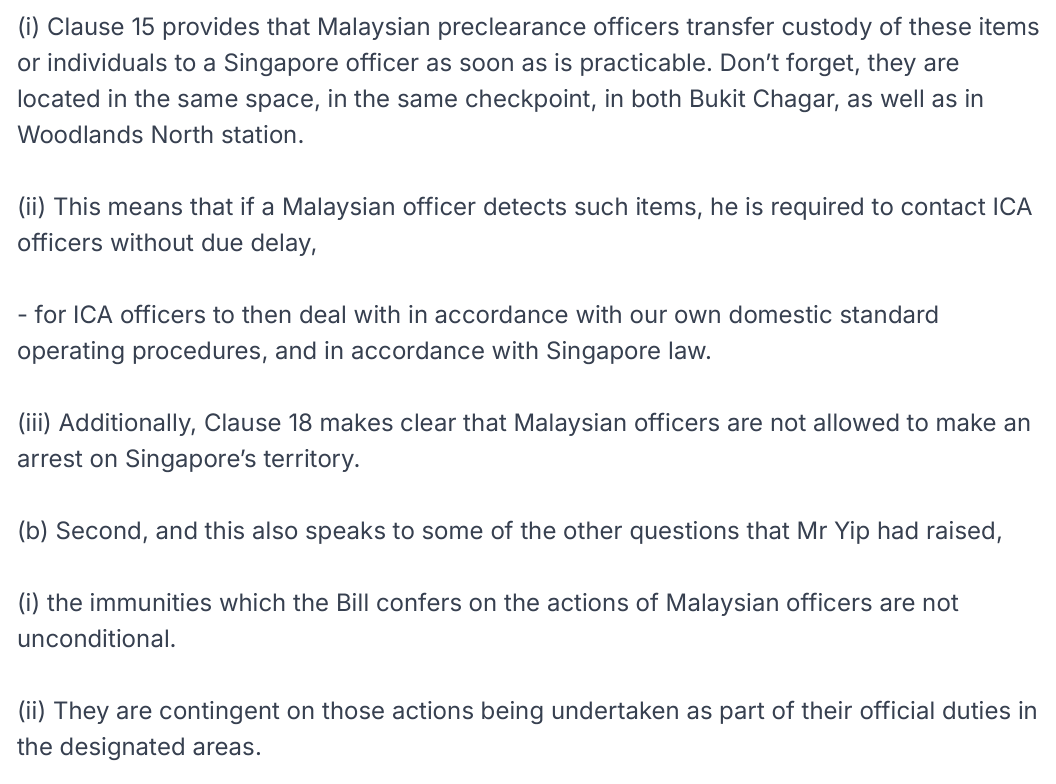
The mechanism is reciprocal juxtaposed border control. Designated Areas demarcate Malaysia's CIQ zone within Woodlands North station (Singapore territory) and Singapore's CIQ zone within Bukit Chagar station (Malaysian territory). Recognised Malaysian preclearance officers in Singapore enjoy specified powers and immunities under Singapore law (deemed public servants under the Penal Code 1871) but cannot make arrests; reciprocal arrangements apply to Singapore preclearance officers in Malaysia. Concurrent criminal jurisdiction follows the principle that the country where the train completes its journey holds the primary right.
The RegLegBrief Specialist Panel considered the Cross-Border Railways (Border Control Co-Location) Bill 2026 (Bill No. 10/2026) text alongside the MHA press release of 7 April 2026 introducing the Bill, the Wrap-up Speech of the Minister for Law and Second Minister for Home Affairs at Second Reading on 5 May 2026, and the parallel Malaysian Johor Bahru–Singapore Rapid Transit System Link Bill 2026 enacted by the Malaysian Parliament in February 2026. Together these documents establish the Singapore architecture and confirm reciprocity at the level of substantive provisions.
Looking outward, the Specialist Panel finds that the Singapore approach belongs to a small but well-established cohort of bilateral juxtaposed-control regimes. The United Kingdom and France first adopted this architecture under the Sangatte Protocol of 25 November 1991 for the Channel Fixed Link, extended by the Additional Protocol of 29 May 2000 to Eurostar termini at London St Pancras and Paris Gare du Nord, with implementation in United Kingdom domestic law via the Channel Tunnel (International Arrangements) Order 1993 (S.I. 1993/1813). The United States and Canada concluded the Agreement on Land, Rail, Marine and Air Transport Preclearance on 16 March 2015, implemented through the Canada Preclearance Act 2016 (S.C. 2017, c. 27) and entering into force in August 2019. The MHA press release explicitly cites the Channel Fixed Link as the comparator for the concurrent-jurisdiction approach.
At the multilateral level, international rail carriage between OTIF member states is governed by the Convention concerning International Carriage by Rail (COTIF) of 9 May 1980, as substantially revised by the Vilnius Protocol of 3 June 1999. The Specialist Panel notes that COTIF establishes uniform rules for passenger and freight contracts but leaves border-control sovereignty to bilateral arrangements of exactly the type Bill No. 10/2026 codifies. The relevant passages from the Wrap-up Speech are reproduced below as direct snapshots from the source release.
The Bill directly engages officers of the Immigration and Checkpoints Authority deployed under the Immigration and Checkpoints Authority Act 2007, Singapore Customs officers under the Customs Act 1960, Singapore Police Force officers under the Police Force Act 2004, Singapore Civil Defence Force officers under the Civil Defence Act 1986, holders of Singapore passports under the Passports Act 2007 travelling on the RTS Link, the Public Prosecutor exercising consent functions under Part 7, legal practitioners admitted to the Singapore Bar advising on cross-border customs and immigration matters, and the RTS Link concessionaire on the Singapore side.
The operational delta is precise. From the Bill's commencement (a date to be appointed by the Minister, expected to align with RTS Link operations in December 2026), Singapore officers may exercise statutory powers in Malaysian territory subject to recognition by Malaysian authorities; Malaysian officers reciprocally operate in the Designated Area at Woodlands North under Malaysian border laws while Singapore criminal law continues to apply outside CIQ-related matters. Inviolability protections under Part 6 secure equipment and data supplied by either Government from seizure or interference by the host state.
Second-order consequences may include recalibration of cross-border insurance products covering Causeway commuters, contractual review of supply agreements for RTS Link station equipment to capture the inviolability framework, and updated training pathways for ICA, Customs, SPF and SCDF officers seconded to Bukit Chagar.
The Bill takes effect on a date to be appointed by the Minister, expected to coincide with the December 2026 commencement of RTS Link passenger operations. Practitioners advising commuters or freight operators should monitor the Commencement Notification, brief clients on the Designated Area at Woodlands North where Malaysian border laws apply, and document the concurrent-jurisdiction principle for incidents in transit. This regulatory development is preserved and cited by RegLegBrief at reglegbrief.com/cite/RLB-SG-2026-00056.