Singapore's Ministry of Manpower gazettes paired Notifications under the Retirement and Re-employment Act 1993 raising the statutory minimum retirement age from 63 to 64 (S 187/2026) and the re-employment age from 68 to 69 (S 188/2026), with both increments commencing 1 July 2026 — the penultimate step on the tripartite roadmap toward 65 and 70 by 2030.
Retirement and Re-employment (Prescribed Minimum Retirement Age) Notification 2026 (S 187/2026 + S 188/2026 · WEF 1 July 2026)
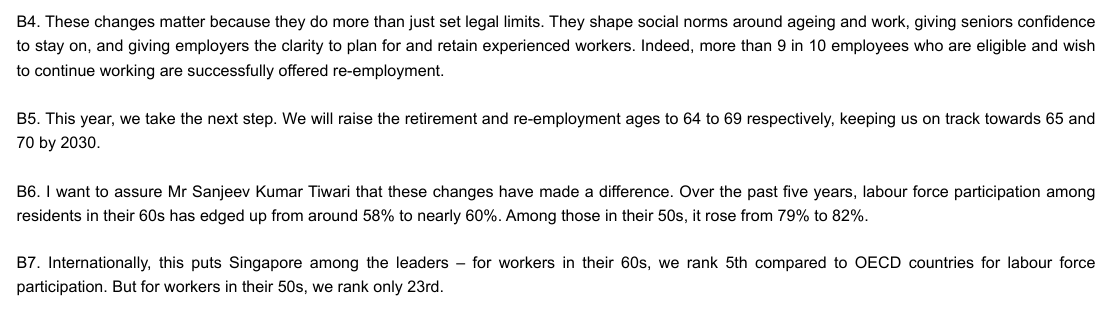
On 1 April 2026 at 5pm, the Government Gazette published two paired Notifications under sections 4(1) and 7A(11) of the Retirement and Re-employment Act 1993: the Retirement and Re-employment (Prescribed Minimum Retirement Age) Notification 2026 (S 187/2026), raising the minimum retirement age from 63 to 64; and the Retirement and Re-employment (Prescribed Re-employment Age) Notification 2026 (S 188/2026), raising the re-employment age from 68 to 69. Both come into operation on 1 July 2026.
Each Notification revokes its 1 July 2022 predecessor — S 546/2022 for retirement age and S 547/2022 for re-employment age. The increment captures employees who attain 63 on or after 1 July 2026 (retirement) and those who attain 68 on or after 1 July 2026 (re-employment); cohorts already past those thresholds remain on prior rules.
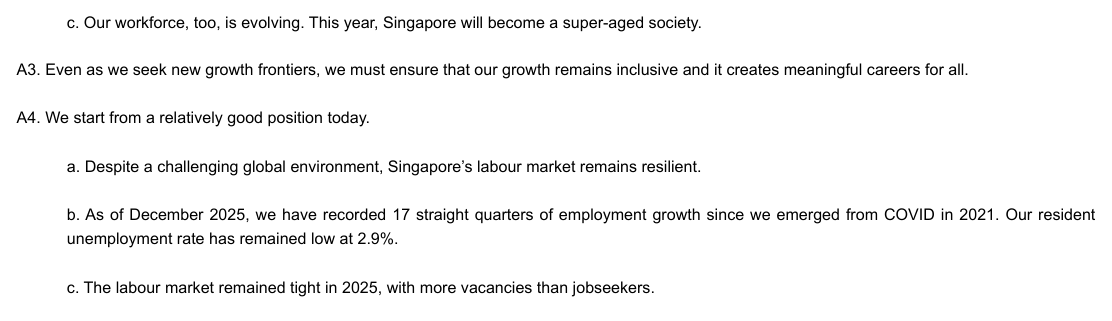
The regulatory rationale, set out in the Tripartite Workgroup on Older Workers Report of August 2019 and reaffirmed in the Ministry of Manpower's Committee of Supply speeches of 3 March 2026, is the demographic transition: Singapore became a super-aged society in 2026. The 1 July 2026 step is the penultimate move on the decade-long roadmap toward retirement age 65 and re-employment age 70 by 2030.
The mechanism is gradualist and tripartite. The Senior Employment Credit, providing wage support of up to seven per cent for workers aged 69 and above, is extended to December 2027. From 2027, Central Provident Fund contribution rates rise by 1.5 percentage points for workers aged above 55 to 60 and 1 percentage point for workers aged above 60 to 65, restoring parity over time with younger-cohort contribution rates.
The full picture requires the document set. The two gazetted Notifications (S 187/2026 and S 188/2026) and the Retirement and Re-employment Act 1993 establish the legal mechanism. The 'Responsible re-employment' Ministry of Manpower information page integrates both Notifications into operational guidance for employers. The Tripartite Workgroup on Older Workers Report (August 2019) frames the policy commitment, and the Committee of Supply 2026 speeches of the Manpower portfolio provide parliamentary framing.
Looking outward, the Singapore step sits within an international pattern of statutory retirement-age adjustment under demographic pressure. The OECD's Pensions at a Glance 2025 records the average normal retirement age across OECD member states rising from 64.7 years (men) and 63.9 (women) retiring in 2024 to 66.4 and 65.9 for those starting work in 2024; future retirement ages span 62 in Luxembourg and Slovenia to 70 or above in Denmark, Italy and the Netherlands.
Closer comparators sit within Asia. Japan's Act on Stabilization of Employment of Elderly Persons sets a statutory mandatory-retirement floor of 60 and, from April 2025, requires employers to employ all applicants who wish to continue working until age 65; the April 2021 amendment imposes a best-efforts obligation to provide employment opportunities to age 70. Korea, the OECD's fastest-ageing economy, is at an old-age dependency ratio comparable with Japan's and is moving on contribution-rate reforms in parallel.
The Notifications directly engage human resources directors and personnel managers of Singapore-incorporated employers, employment lawyers admitted to the Singapore Bar advising on contract-of-service obligations, payroll operations administering Central Provident Fund contributions on behalf of CPF Board, Tripartite Alliance for Fair and Progressive Employment Practices alliance members, public accountants registered with the Accounting and Corporate Regulatory Authority advising on employment-cost accruals, and Singapore citizens and Singapore permanent residents born on or after 1 July 1963 (retirement-age cohort) and on or after 1 July 1958 (re-employment-age cohort).
The operational delta is precise. From 1 July 2026, employers may not dismiss an employee on grounds of age before the new minimum retirement age of 64; they must offer re-employment to eligible employees up to age 69 rather than 68; the Tripartite Guidelines on Re-employment of Older Employees apply unchanged in structure but at the new ceiling. Employers unable to re-employ in-house must transfer the obligation to another employer or pay the Employment Assistance Payment.
Second-order consequences include possible recalibration of group-life and group-medical insurance premium structures referenced to retirement age, executive remuneration vesting schedules anchored on the statutory retirement age, and the structuring of Voluntary Early Retirement Schemes around the higher floor.
The Notifications come into operation on 1 July 2026. Human resources teams should update employee handbooks, contract templates and Tripartite Guidelines compliance documentation; identify the cohort of employees turning 63 between 1 July 2026 and the next age-65 step; and prepare re-employment offers at least three months before each affected employee's retirement date. This regulatory development is preserved and cited by RegLegBrief at reglegbrief.com/cite/RLB-SG-2026-00051.