Singapore's Ministry of Health issues the Cybersecurity and Data Security Essentials under the Health Information Act framework, requiring thirteen baseline controls and a two-hour incident-notification timeline from every Healthcare Services Act licensee and National Electronic Health Record contributor before the Act's commencement in early 2027.
Cybersecurity and Data Security Essentials (CS/DS Essentials/2026 (First Edition) · Pub 28 February 2026)
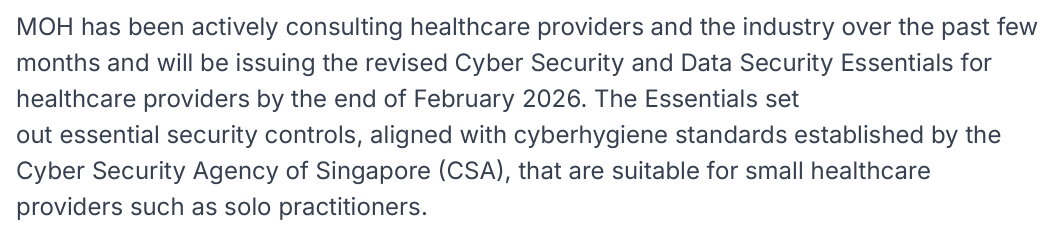
On 25 February 2026, the Ministry of Health (MOH) of Singapore confirmed that the Cybersecurity and Data Security Essentials would be issued by the end of the month, with the first edition formally dated March 2026 (CS/DS Essentials/2026, First Edition). The Essentials are issued under the Health Information Act framework, with the underlying statute passed by Parliament on 12 January 2026 as Bill No. 20/2025; the Health Information Act is intended to commence in early 2027. The Essentials set out thirteen control domains across three pillars: cybersecurity (IT and software measures), data security (data-related practices), and common practices spanning personnel training, vendor management and organisation protocols. They replace the Cyber and Data Security Guidelines for Healthcare Providers issued by MOH in December 2023.
The regulatory rationale, set out in the Second Reading speeches of 12 January 2026 and the supporting press releases, is grounded in Singapore's demographic shift. A rapidly ageing population imposes a greater burden of chronic disease and requires coordinated care across acute hospitals, General Practitioner clinics, community hospitals, dialysis centres, home medical services and dental clinics. The National Electronic Health Record (NEHR) was developed to ensure each provider has access to a consistent patient summary, but expanded contribution and access materially raises cybersecurity exposure. The Essentials respond to public consultation feedback that small healthcare providers — solo practitioners and General Practitioner clinics — require clear baselines aligned with cyberhygiene standards established by the Cyber Security Agency of Singapore. MOH is concurrently engaging Health Information Management Systems vendors to embed key controls into Clinic Management System products under the Cyber Essentials certification scheme.
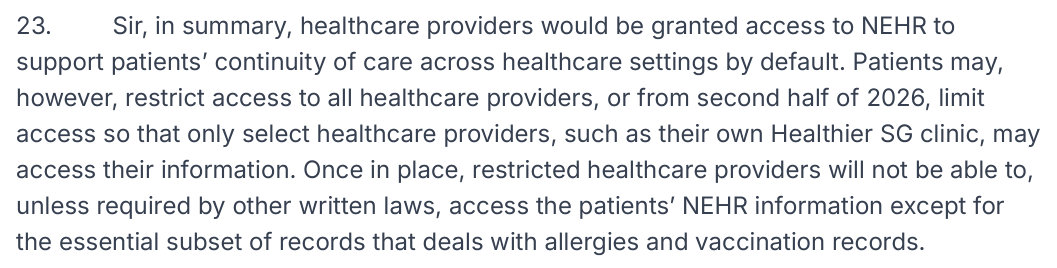
The analytical picture requires the full document set. The Health Information Bill (Bill No. 20/2025) establishes the statutory framework. The Second Reading opening and closing speeches of the Senior Minister of State for the Ministry of Digital Development and Information and the Ministry of Health (12 January 2026) state policy rationale and elaborate the safeguards architecture, including criminal penalties for unauthorised access. The MOH press release of 12 January 2026 frames the operational mechanism (NEHR contribution, access restrictions, and the 'break glass' override for emergencies). The MOH press release of 25 February 2026 announces issuance of the Essentials. Together these documents establish that the Essentials translate Health Information Act protection obligations into a control baseline that references the Personal Data Protection Act 2012, Healthcare Services Act licence conditions, the CSA Cyber Essentials certification scheme, and National Institute of Standards and Technology guidance for media sanitisation. The relevant passages from each document are reproduced below as direct snapshots from the source releases.
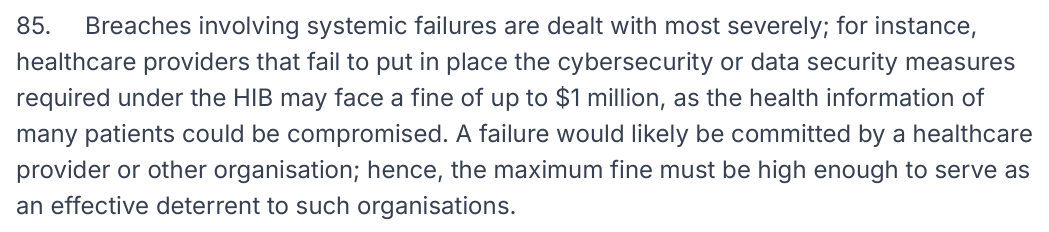
The Essentials apply to all 'HIA entities': every licensee under the Healthcare Services Act 2020, every contributor to and user of the National Electronic Health Record, and prescribed entities enabled to share health information under the Health Information Act. Categories facing direct compliance obligations include public healthcare institutions licensed under the Healthcare Services Act, medical practitioners registered with the Singapore Medical Council under the Medical Registration Act when supervising clinical IT systems, compliance officers and Chief Information Security Officers of MOH-licensed healthcare providers, cybersecurity service providers licensed under the Cybersecurity Act 2018 servicing healthcare clients (including CSA-qualified CISO-as-a-service consultancies), and Health Information Management Systems vendors offering Cyber Essentials-certified Clinic Management System products. The operational delta from the December 2023 Guidelines is an explicit two-hour initial notification window to MOH for confirmed cybersecurity incidents and notifiable data breaches, with a written incident report due within fourteen days. Notification thresholds align with the Personal Data Protection Act: significant harm or 500 or more affected individuals. Unauthorised access to NEHR by healthcare professionals attracts a maximum fine of S$50,000 and up to two years' imprisonment for first offences, doubled for repeat offenders, with referral to the relevant Professional Boards or Councils.
The Health Information Act is intended to commence in early 2027, and healthcare providers should treat the intervening period as the transition window for Essentials compliance. The Ministry of Health has signalled that further resources — a guidebook, templates, infographics, training courses and a HIA implementation guide — will be progressively issued over the course of 2026. Healthcare providers must update software inventories, implement two-factor authentication for administrative access to internet-facing systems containing health information, formalise data classification and retention policies aligned with Healthcare Services Act licence conditions, document vendor responsibilities for data location and incident response, and stand up an incident response plan capable of meeting the two-hour notification timeline. This regulatory development is preserved and cited by RegLegBrief at reglegbrief.com/cite/RLB-SG-2026-00048.