Singapore's Ministry of Home Affairs commences three Road Traffic Act and Road Vehicles (Special Powers) Act amendments under Act 5 of 2026 on 14 April 2026 — clarifying that mandatory disqualification periods are minimum baselines, making vehicle forfeiture discretionary where the offender is not the owner, and permitting Singapore Armed Forces drivers to drive leased Armed Forces vehicles.
Land Transport and Related Matters Act 2026 — Commencement of RTA and RVSPA Provisions (Act 5 of 2026 (LTRMA) — MHA Commencement (14 April 2026) · WEF 14 April 2026)
On 14 April 2026, the Ministry of Home Affairs (MHA) of Singapore commenced three provisions of the Land Transport and Related Matters Act 2026 (Act 5 of 2026) amending the Road Traffic Act 1961 and the Road Vehicles (Special Powers) Act 1960. Mandatory disqualification periods under the Road Traffic Act become minimum baselines that the court may extend up to lifetime disqualification; vehicle forfeiture under the Road Vehicles (Special Powers) Act becomes discretionary where the offender is not the owner and used the vehicle without consent; and Singapore Armed Forces drivers may drive vehicles either owned or leased by the Singapore Armed Forces.
The parent Act 5 of 2026 was passed by Parliament on 5 February 2026, assented to by the President on 23 February 2026, and gazetted in Acts Supplement No. 5 on 24 February 2026 at 10am. It is a joint Bill of the Ministry of Transport and the Ministry of Home Affairs amending six Acts.
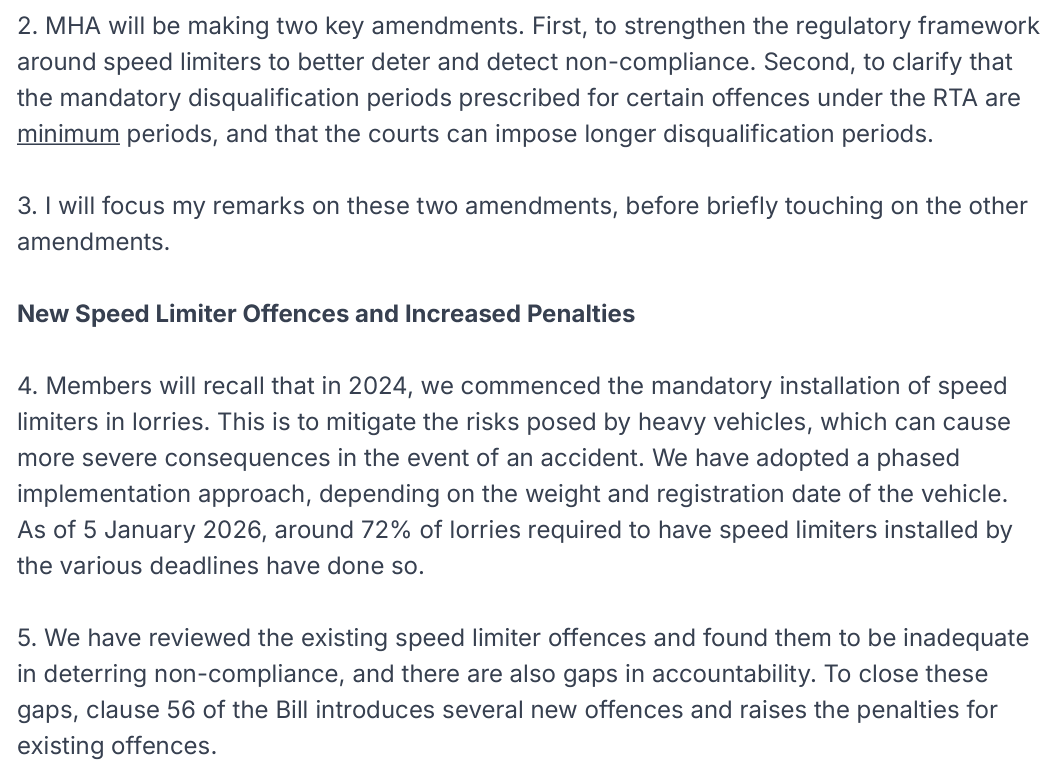
The regulatory rationale, set out in the MHA explainer of 12 January 2026 and the Senior Minister of State for the Ministry of Foreign Affairs and the Ministry of Home Affairs' Second Reading and Closing speeches of February 2026, is twofold: judicial flexibility and proportionality. The disqualification clarification removes ambiguity that mandatory minimums functioned as ceilings; the forfeiture amendment ends the disproportionate result of forfeiting a vehicle from an innocent owner whose vehicle was used without consent.
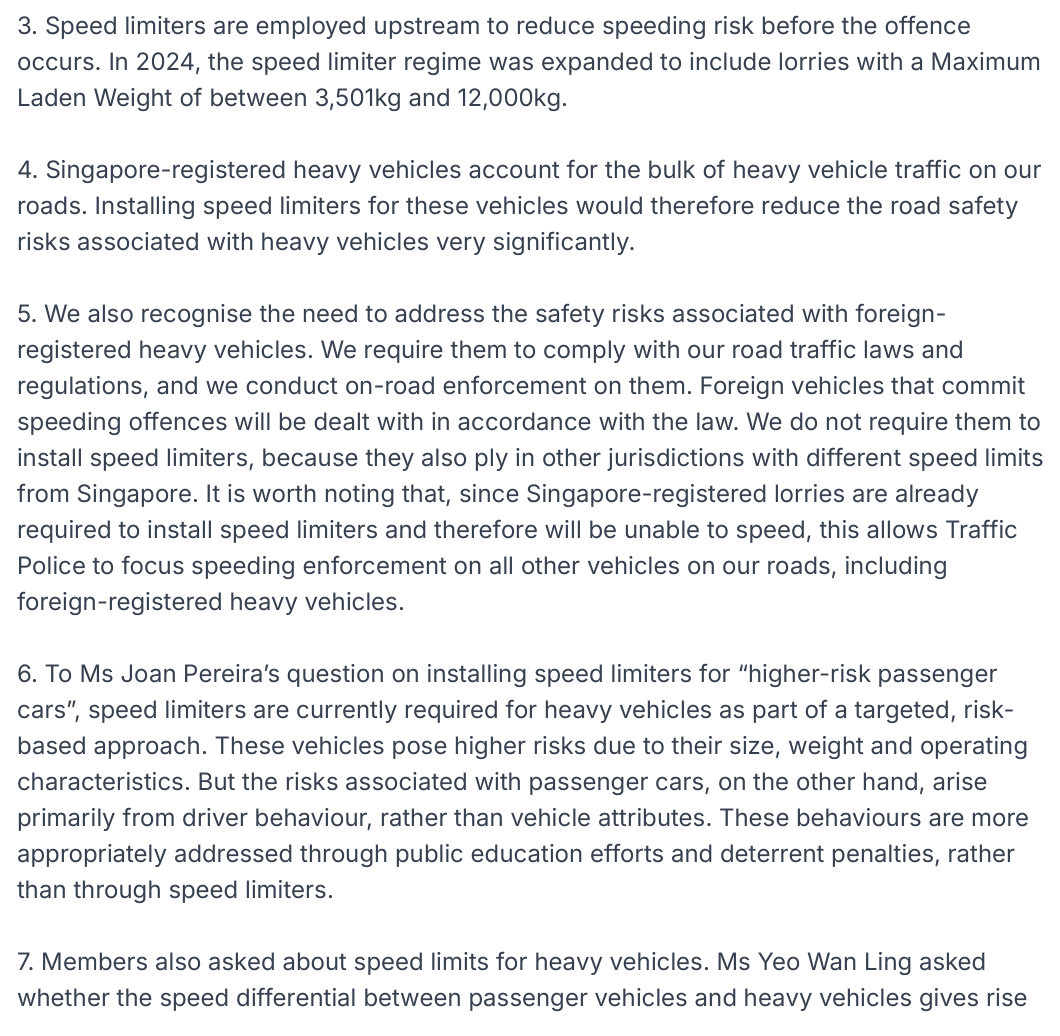
The mechanism is statutory. Sections 64, 65, 67, 68, 79, 84 and 116 of the Road Traffic Act 1961 — covering reckless driving, driving without due care, drink-driving offences, heavy-vehicle escort breaches, hit-and-run and unlawful speed trials — now carry disqualification floors rather than fixed periods. Other MHA provisions, including new speed-limiter offences for lorries between 3,501 kg and 12,000 kg maximum laden weight effective from 1 July 2027, commence at a later phase.
The RegLegBrief Specialist Panel considered the MHA Commencement press release of 14 April 2026 alongside the full text of Act 5 of 2026, the MHA explainer of 12 January 2026, the Senior Minister of State's Second Reading and Closing speeches, the Acting Minister for Transport's Opening speech, and the Ministry of Transport's Bill introduction press release. Together these documents establish that this is the first of multiple commencement waves for Act 5 of 2026 — separate Commencement Notifications by the Ministry of Transport and the Land Transport Authority address active mobility, Electronic Road Pricing and Land Transport Authority Act amendments under their respective purviews.
Looking outward, the Specialist Panel finds that the Singapore framework converges with peer jurisdictions on judicial-discretion floors. In the United Kingdom, section 59 of the Police Reform Act 2002 and section 165A of the Road Traffic Act 1988 grant vehicle-seizure powers for inconsiderate and uninsured driving with judicial discretion on disposal; the Road Traffic Offenders Act 1988 treats disqualification periods as minimums with courts free to extend. In New South Wales, sections 241 to 243 of the Road Transport Act 2013 vest comparable seizure powers, while Tasmania Police impose clamping and twenty-eight-day impoundments under state road-transport statutes.
The Specialist Panel notes that Singapore's narrower change — making forfeiture discretionary only where the offender is not the owner and the vehicle was used without consent — preserves the RVSPA's strong deterrent posture for owner-offenders while restoring proportionality for innocent third-party owners. The disqualification clarification likewise expands court discretion without lowering any statutory floor.
The 14 April 2026 commencement directly engages holders of driving licences issued under the Road Traffic Act 1961, Singapore Police Force Traffic Police officers, criminal lawyers admitted to the Singapore Bar conducting traffic-offence defence, Magistrates and District Judges of the State Courts hearing Road Traffic Act prosecutions, owners of vehicles registered under the Land Transport Authority of Singapore Act 1995 contesting forfeiture proceedings under the Road Vehicles (Special Powers) Act 1960, and Singapore Armed Forces personnel with military driving licences under the Singapore Armed Forces Act 1972 driving Singapore Armed Forces-leased vehicles.
The operational delta is precise. From 14 April 2026, sentencing submissions on disqualification must address the full statutory range up to lifetime disqualification rather than treating the mandatory minimum as a likely outcome; defence representations on RVSPA forfeiture from non-owner offenders may now invoke the discretionary framework; and Singapore Armed Forces driver authorisations no longer require written-off proof of vehicle ownership distinct from leasehold.
Second-order consequences may include longer driving disqualifications in serious cases, recalibration of motor insurance premium underwriting against the new sentencing distribution, and contractual review of Singapore Armed Forces leased-vehicle agreements with commercial fleet providers.
The three commencement provisions take effect on 14 April 2026. Practitioners should brief clients on the disqualification-baseline interpretation, advise non-owner-offender clients on the discretionary forfeiture framework, and review Singapore Armed Forces driver authorisations. Subsequent commencement waves under Act 5 of 2026 — including the speed-limiter offences from 1 July 2027 and the Ministry of Transport active mobility and Electronic Road Pricing provisions — follow on separate dates. This regulatory development is preserved and cited by RegLegBrief at reglegbrief.com/cite/RLB-SG-2026-00055.